By Mg Phyu Phway
October 1, 2026
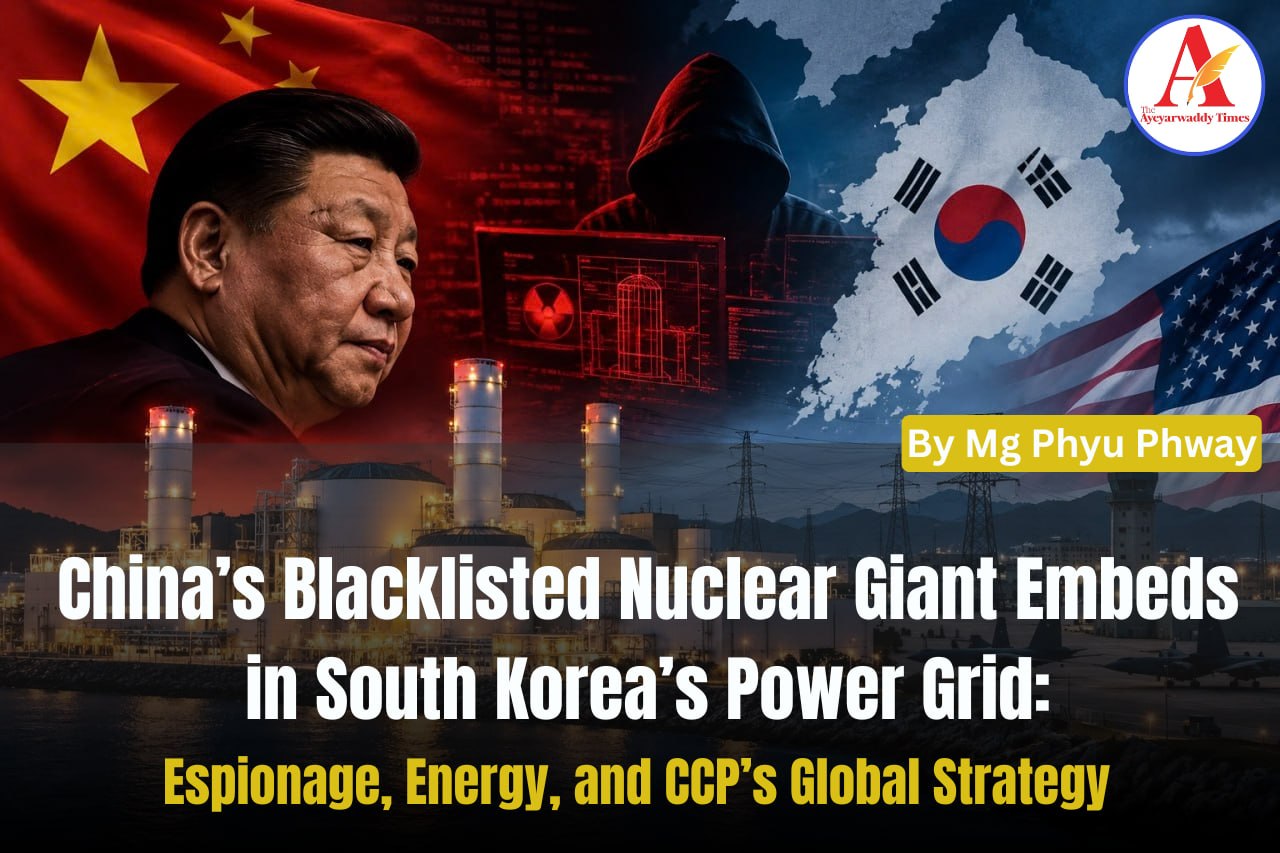
China’s state-owned nuclear enterprise has long stood at the centre of global controversy. Blacklisted by the United States for decades of nuclear espionage, it now operates five power plants in South Korea, embedding itself in critical infrastructure alarmingly close to American military bases. This expansion is not simply about energy; it represents a calculated infiltration that underscores Beijing’s use of commerce as a cloak for espionage, raising urgent national security concerns for both Seoul and Washington.
The company’s history is inseparable from allegations of espionage. Investigations revealed that for nearly two decades, advanced nuclear reactor designs were systematically stolen through joint ventures and partnerships, enabling infiltration of US nuclear networks. By 2019, the enterprise was placed on the US Department of Commerce’s Entities List, effectively banning American firms from engaging with it. Simultaneously, it was identified as a Chinese military company, highlighting the dual-use nature of its projects, civilian energy ventures that could be weaponized for military purposes. This pattern of theft is not isolated. China has repeatedly been accused of proliferating nuclear and missile technology to states such as Iran, North Korea, and Pakistan, undermining global non-proliferation frameworks and destabilizing regional security. Despite its blacklisting, the enterprise has entrenched itself in South Korea’s energy sector. Through subsidiaries wholly owned by the parent company, facilities with a combined capacity of 2.2 gigawatts (GW) are now operational.
The Daesan LNG Plant, which is situated in Seosan city, South Chungcheong Province, South Korea, commissioned in July 2026, is a 557 MW combined cycle facility situated within the Daesan Industrial Complex. Designed to generate approximately 3.9 terawatt-hours of electricity annually, it supplies power both to the national grid and to petrochemical industries. Its location, just 45 miles from a major US military base, makes its presence strategically sensitive. Alongside this, the Yulchon Combined Cycle Plant in Gwangyang, with a capacity of 1,390 MW, provides electricity to key industrial sectors including steel and petrochemicals. Positioned within a vital industrial hub, it underscores the depth of integration into South Korea’s economic backbone. These subsidiaries are not independent private entities, as often portrayed, but direct extensions of a state-owned enterprise and, by implication, instruments of the CCP.
The strategy employed here is clear: foreign investment is used not simply for economic gain but as a means of embedding influence and intelligence operations. The expansion into South Korea mirrors earlier patterns seen elsewhere, where critical infrastructure became a convenient entry point. By positioning itself within such networks, Beijing gains access to energy systems with the latent ability to disrupt or manipulate power distribution. It also creates opportunities to gather intelligence under the guise of commercial activity, while the proximity of these facilities to American military bases provides strategic leverage.
In essence, commerce is weaponized, transforming energy projects into platforms that serve both economic and espionage purposes, with the potential to undermine security at a national and regional level. The presence of this enterprise in South Korea must be understood within the broader framework of Chinese intelligence activity. Recent cases have underscored persistent attempts to acquire sensitive military technologies, including missile defence systems. Such incidents confirm that espionage in the region is not episodic but systemic. Globally, China’s continued proliferation of nuclear and missile technology to rogue states undermines international security regimes. Moreover, the reactor designs stolen from the United States are not confined to civilian applicationsthey carry military potential, offering Beijing a strategic edge in global competition.
South Korea’s reliance on this enterprise creates a layered national security challenge that goes well beyond energy supply. While foreign investment strengthens electricity generation and supports industries, dependence on a company controlled by the CCP introduces structural vulnerabilities. Critical infrastructure could be manipulated or disrupted in times of conflict, giving Beijing leverage over national stability. The risks are magnified by the presence of US forces in Korea, as facilities located near military bases could directly affect alliance readiness if power supply were interrupted.
Energy security, therefore, cannot be separated from defence security. Adding to the concern are policy blind spots: subsidiaries are often misrepresented as “private,” masking their direct ties to Beijing’s state apparatus. This mischaracterization fosters complacency and underestimates the scale of infiltration. Taken together, energy dependence, alliance risks, and policy misperceptions converge into a fragile security environment where commerce and espionage blur dangerously.
The expansion of this blacklisted enterprise in South Korea is not a mere energy investmentit is a strategic infiltration orchestrated by the CCP. By embedding itself in critical infrastructure, Beijing gains leverage over Seoul’s economy and Washington’s military presence. The lesson is stark: permitting Chinese state-owned enterprises into vital sectors is tantamount to inviting espionage and sabotage. South Korea and the United States must urgently reassess the risks posed by these operations. Energy security cannot be separated from national security, and the presence of a blacklisted Chinese company in critical infrastructure is a vulnerability too dangerous to ignore.
(The author, Mg Phyu Phway, is a researcher who studies and monitors Asia-Pacific affairs.)