By Mg Phyu Phway
November 29, 2026
Revised rules seek to curb one-man rule, strengthen collective decision-making and prevent local officials from undermining Beijing’s policy priorities.
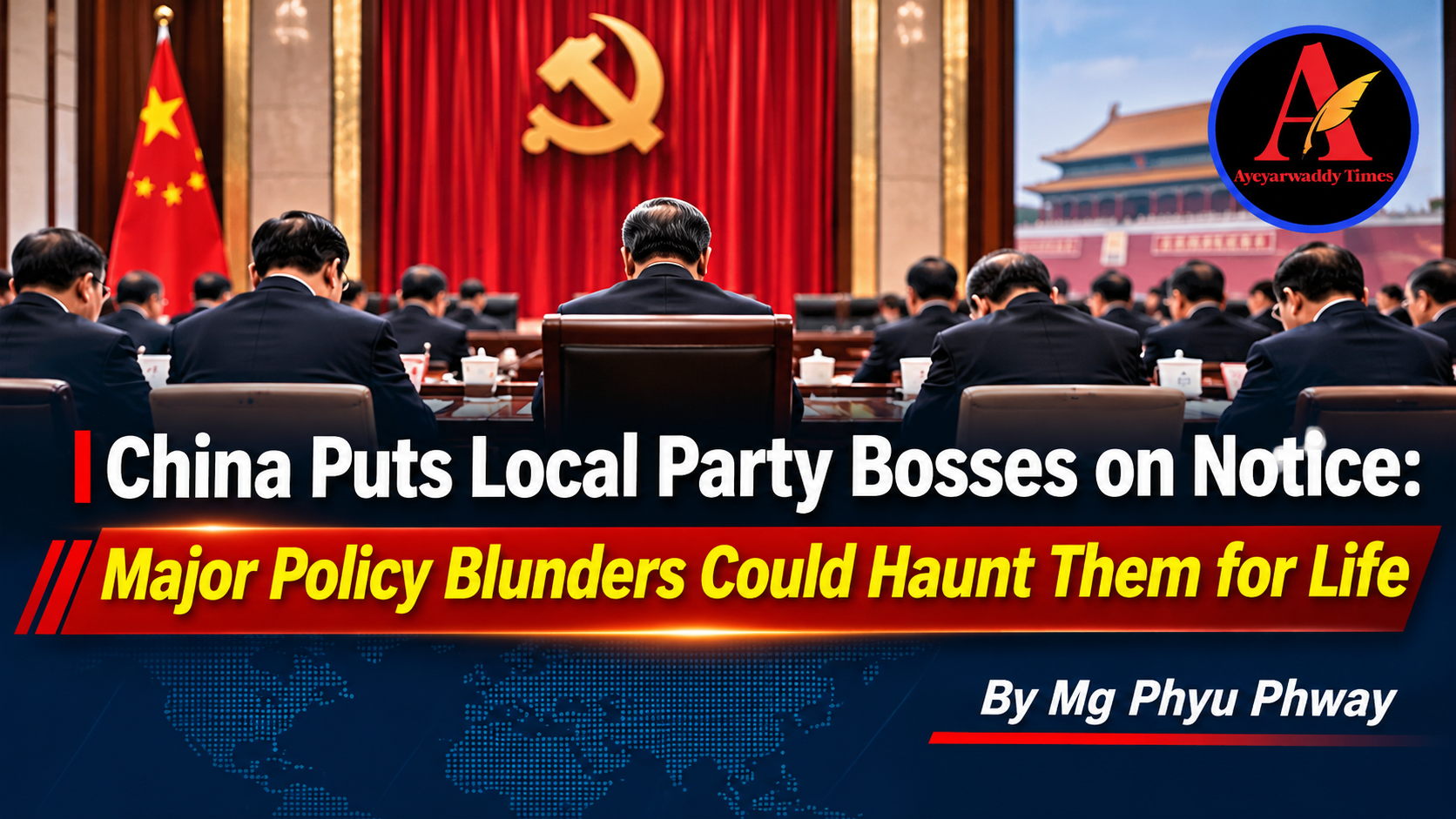
China has moved to tighten internal discipline across its vast local Communist Party machinery, introducing revised regulations that seek to rein in the authority of local party secretaries, strengthen collective leadership and make officials personally accountable for major decision-making failures, potentially for life.
The revised rules, the first comprehensive update in a decade, underline Beijing’s growing concern over the gap between central policy directives and their implementation at provincial, municipal and county levels. They also reflect President Xi Jinping’s continuing drive to centralise political control while making local leadership more disciplined and responsive to the priorities of the Communist Party’s central leadership.
Announced by state news agency Xinhua, the regulations place particular emphasis on supervising principal leaders, or yi ba shou – the top officials who exercise considerable influence over party and government institutions at each administrative level.
A central feature is the renewed insistence on democratic centralism, a foundational Communist Party principle that permits internal deliberation but demands collective adherence to decisions once taken. The rules explicitly prohibit party secretaries from placing themselves above their organisations, imposing personal preferences on committees or arbitrarily overturning collective decisions.
Significantly, the revised framework introduces a ‘last-to-speak’ requirement for party secretaries at standing committee meetings. They must express their views only after other members have spoken, allowing alternative opinions and objections to emerge before the principal leader states a position. The provision is intended to reduce the influence of hierarchical pressure and prevent collective deliberations from becoming formal endorsements of decisions already made by powerful local chiefs.
The emphasis is especially consequential for decisions involving major policy initiatives, senior personnel appointments, infrastructure projects and substantial public expenditure – areas where local officials have traditionally enjoyed considerable discretion.
The regulations also seek to address economic and administrative excesses that have repeatedly complicated Beijing’s policy objectives. Local committees are prohibited from pursuing wasteful prestige projects, launching resource-intensive campaign-style initiatives, creating fresh hidden government debt or adopting protectionist measures that undermine the development of a unified national market.
These restrictions point to a wider problem confronting China’s central leadership – local governments have often pursued growth targets and political ambitions through excessive borrowing, poorly conceived infrastructure investments and policies favouring local interests over national economic integration.
Perhaps the most consequential provision concerns personal accountability. Party secretaries and standing committee members involved in major decision-making errors can be held responsible for life. Conversely, members who explicitly record their opposition or reservations during deliberations may be exempted from responsibility or have their accountability waived.
This provision serves two purposes. It raises the potential cost of reckless decisions while giving committee members an institutional basis to challenge proposals backed by powerful superiors. Whether it encourages genuine debate or simply produces more cautious, risk-averse officials will depend on how consistently the rules are enforced.
The revised framework follows a resolution on internal discipline adopted at the Communist Party Central Committee’s fifth plenum last month. A subsequent People’s Daily commentary warned local committees against paying lip service to central directives or creating ‘middle obstruction’ – bureaucratic bottlenecks that distort or prevent the implementation of policies issued by Beijing.
Ultimately, the revisions are about more than administrative efficiency. They seek to ensure that China’s local power structures remain subordinate to central political authority. By combining tighter supervision, collective decision-making requirements and lifetime accountability, Beijing is attempting to discipline local leadership without diluting the party’s command structure.
The underlying message is unmistakable – local leaders may exercise administrative authority, but they cannot treat it as personal political power.
(The author, Mg Phyu Phway, is a researcher who studies and monitors Asia-Pacific affairs. This article represents the author’s personal views and opinions only and does not necessarily reflect the views or opinions of Ayeyarwaddy Times Media)