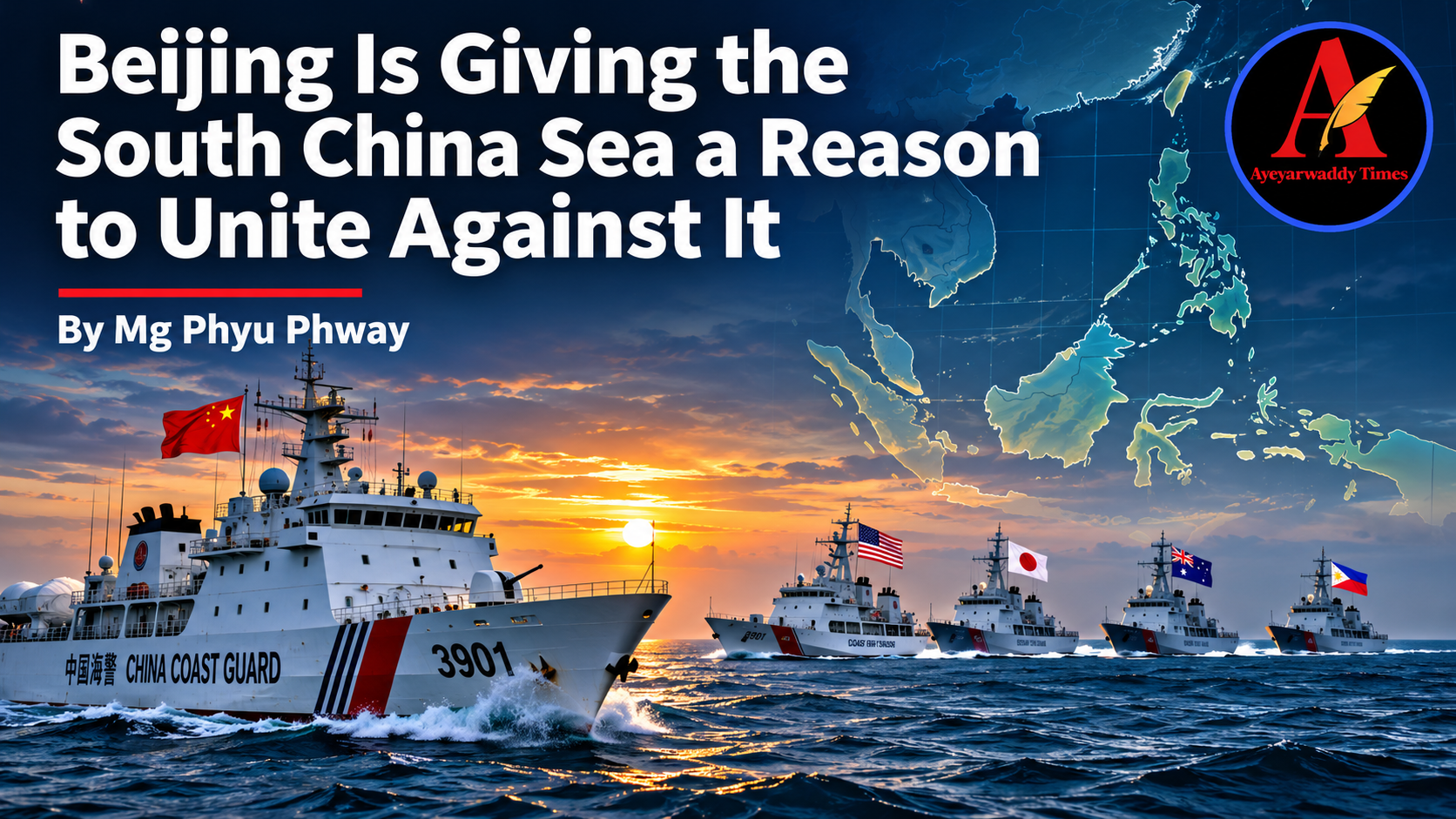
By Mg Phyu Phway
November 22, 2026
Tn the first six months of 2026, Chinese coastguard vessels spent 933 ship-days patrolling around Scarborough Shoal in the South China Sea, nearly matching their entire presence during 2025. The figures also recorded 112 days of interactions between Chinese and Philippine government vessels during the same period. A persistent group of six to eight Chinese maritime militia vessels operated closer to the shoal, while coastguard ships maintained a wider perimeter around it. These were not isolated patrols but a sustained effort to establish a physical presence in waters claimed by the Philippines.
Against this backdrop, the United States, Japan, Australia and the Philippines have agreed to establish a Combined Coordination Centre in the Philippines. Announced on November 10 following a meeting of their defence ministers in Cebu, the initiative is intended to improve information sharing, joint surveillance and operational coordination. The four countries have also committed to synchronising defence investments, expanding military exercises and strengthening interoperability.
The arrangement is an important development in the South China Sea, not because it creates another military alliance, but because it addresses a problem that has repeatedly worked in Beijing’s favour. China’s coastguard and maritime militia can maintain a near-continuous presence in disputed waters, while the responses of other countries have often been fragmented. A more coordinated regional presence could make it harder for Beijing to use that imbalance to gradually extend its control.
China’s grey-zone tactics are changing the nature of the dispute
The South China Sea dispute is often described as a contest over sovereignty and maritime boundaries. But the immediate challenge facing regional countries is increasingly about access and control. Chinese vessels do not need to occupy another country’s territory to restrict its ability to exercise maritime rights. They can shadow fishing boats, obstruct resupply missions, establish patrol perimeters and use water cannons or dangerous manoeuvres to discourage other vessels from entering contested waters.
The Philippines has experienced this repeatedly. In June 2024, Chinese coastguard personnel boarded Philippine vessels attempting to resupply the grounded BRP Sierra Madre at Second Thomas Shoal. The confrontation left several Filipino personnel injured, including one sailor who lost a thumb. Although Manila and Beijing subsequently reached a provisional arrangement to facilitate resupply missions, the agreement did not resolve the underlying dispute.
Scarborough Shoal has since become another focal point. In July 2026, the Philippine Coast Guard accused Chinese vessels of using water cannons against Philippine government ships supporting local fishermen. Twelve Chinese coastguard vessels and three maritime militia vessels were reportedly involved in the confrontation. In September, a Chinese coastguard vessel rammed a Philippine fisheries vessel carrying fuel for fishermen, damaging its railings and deck structures.
These incidents demonstrate why conventional military deterrence alone is insufficient. Beijing has increasingly relied on vessels that operate below the threshold of armed conflict, allowing it to exert pressure without necessarily triggering a military response. A naval deployment may be interpreted as escalation, but a coastguard patrol can be presented as routine law enforcement. The distinction creates political and operational difficulties for countries attempting to defend their maritime rights.
It also gives China an advantage in maintaining pressure over extended periods. A country responding to every encounter individually must continually mobilise its coastguard, naval and diplomatic resources. China, with its larger fleet and extensive maritime infrastructure, is better positioned to sustain that effort.
From occasional exercises to a continuous regional presence
This is where the four-country arrangement was seen as a necessity. Its most immediate value is the ability to connect the activities of four countries that possess complementary capabilities. Philippines brings geographical proximity and direct operational experience in the disputed waters. Japan has considerable maritime surveillance capabilities, sophisticated coastguard infrastructure and a growing interest in regional security. Australia contributes naval reach, intelligence capabilities and experience in multilateral operations. The United States brings extensive regional military infrastructure, intelligence assets and established defence commitments to Manila.
Individually, these capabilities already exist. The difficulty has been coordinating them in a manner that produces a sustained operational picture. A Combined Coordination Centre could help address this by allowing the four countries to share information more systematically, track vessel movements and coordinate their responses to emerging incidents.
The importance of such coordination becomes clearer when viewed against China’s operations around Scarborough Shoal. AMTI’s 2026 assessment found that Chinese coastguard patrols had increased to 933 ship-days in just six months. It also recorded interactions between Chinese and Philippine vessels on 112 days. Having a shared understanding of these movements would help regional governments identify changes in Chinese deployments, distinguish routine activity from unusual concentrations and respond before a confrontation develops.
It would also improve the documentation of incidents. China’s maritime operations frequently involve competing accounts of what happened, particularly when vessels obstruct one another or engage in dangerous manoeuvres. Shared surveillance and a common evidentiary record would make it more difficult for such incidents to disappear into diplomatic exchanges and conflicting official statements.
Why the arrangement matters beyond the Philippines
The proposed centre also has implications for other Southeast Asian countries. Vietnam, Malaysia, Indonesia and Brunei have their own maritime disputes with China, even though their relationships with Beijing differ considerably from that of the Philippines.
China’s activities have not been limited to Philippine-claimed waters. Its coastguard has maintained a persistent presence near Malaysia’s offshore energy operations around Luconia Shoals, while Chinese vessels have repeatedly operated near Indonesia’s Natuna Islands, where Beijing’s maritime claims overlap with Indonesia’s exclusive economic zone. Vietnam has also faced Chinese interference with fishing and maritime activities in waters it claims.
The 2016 arbitral tribunal ruling under the United Nations Convention on the Law of the Sea rejected the legal basis for China’s expansive historic-rights claims within the nine-dash line and affirmed the Philippines’ sovereign rights in relevant parts of its exclusive economic zone. Beijing rejected the ruling and continues to refuse to recognise it.
This is precisely why the four-country initiative should not be reduced to a US-led effort to contain China. Its wider purpose should be to reinforce the principle that maritime rights cannot be determined by whichever country can maintain the largest number of vessels in disputed waters. A regional response based on surveillance, information sharing and consistent documentation would also give smaller coastal states greater confidence in defending their interests.
That does not mean ASEAN should be sidelined. A four-country arrangement cannot substitute for a regional diplomatic framework, particularly when several Southeast Asian countries remain reluctant to take sides in strategic competition between Washington and Beijing. Its value will depend partly on whether it supports, rather than undermines, broader efforts to establish common rules for maritime conduct.
Deterrence without turning the South China Sea into a military contest
There are also limits to what the new centre can achieve. The November announcement provides no detailed timeline, permanent staffing arrangements or precise operational mandate. It does not establish a NATO-style collective defence commitment, nor does it mean that the four countries will automatically respond militarily to every Chinese action.
An arrangement intended to discourage coercion should not become a mechanism that increases the likelihood of confrontation. If Beijing interprets every joint patrol or surveillance operation as an attempt to encircle China, it could respond with larger deployments and more aggressive manoeuvres. Regional governments will therefore need to maintain communication channels and ensure that their cooperation remains focused on maritime security and the enforcement of international law.
Beijing has long argued that external powers should stay out of the South China Sea dispute. But its own conduct has made it increasingly difficult to treat the issue as a matter that can be managed through bilateral negotiations alone.
The four-country defence centre will not resolve the South China Sea dispute. Yet, its importance lies in making regional cooperation more practical and less dependent on occasional diplomatic statements or military exercises. If China continues to rely on persistent maritime pressure to advance its claims, its neighbours will have greater reason to coordinate their responses. Beijing may regard the arrangement as an attempt to constrain its influence. In many ways, however, it is the increasingly assertive use of that influence that has made such cooperation necessary.
(The author, Mg Phyu Phway, is a researcher who studies and monitors Asia-Pacific affairs. This article represents the author’s personal views and opinions only and does not necessarily reflect the views or opinions of Ayeyarwaddy Times Media)


