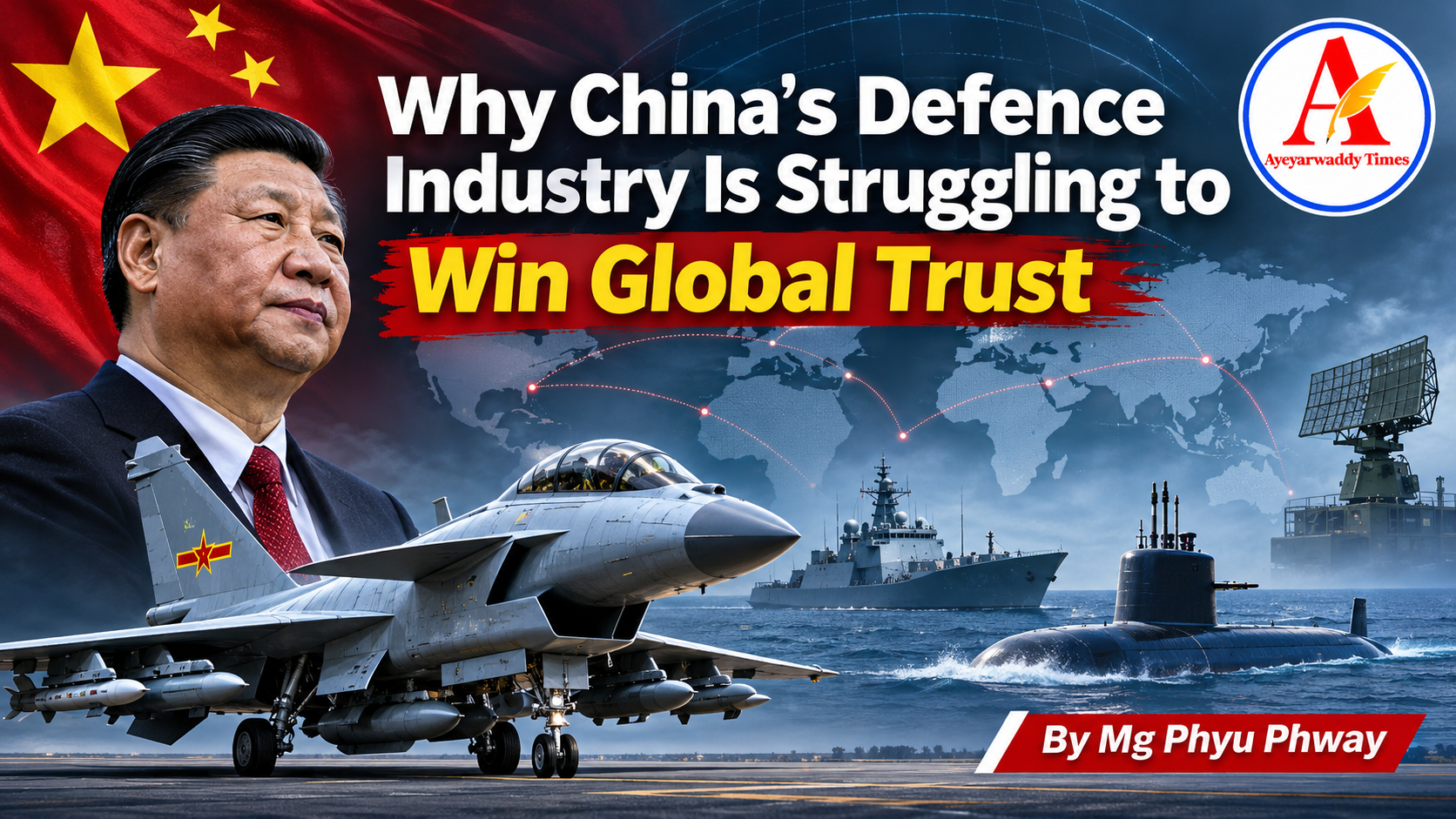
By Mg Phyu Phway
November 20, 2026
China has become the world’s fifth-largest arms exporter, accounting for 5.6 per cent of global arms transfers between 2021 and 2025. Its exports grew by 11 per cent compared with the previous five-year period, placing it among the established suppliers of major military equipment. However, the distribution of these sales also reveals a limitation. Pakistan accounted for 61 per cent of China’s arms exports during this period, while the remaining sales were spread across 46 other countries. For a defence industry seeking a larger international market, this degree of dependence on a single customer is significant.
The problem is not that countries are unwilling to purchase Chinese military equipment. Several have done so, attracted by competitive prices, fewer political conditions and Beijing’s willingness to offer financing and technology partnerships. The difficulty is converting these advantages into lasting confidence. From Turkey’s cancellation of a major missile defence contract to Thailand’s prolonged uncertainty over a Chinese submarine and Myanmar’s problems with its JF-17 fleet, questions about reliability, interoperability and after-sales support have repeatedly surfaced.
China’s defence industry has made considerable technological progress, but manufacturing an advanced weapon is different from establishing a dependable defence supply relationship. This difference is increasingly shaping how prospective buyers assess Chinese military equipment.
A growing exporter with a concentrated customer base
China’s share of global arms exports increased from 5.5 per cent in 2016–20 to 5.6 per cent in 2021–25. However, 77 per cent of its exports went to Asia and Oceania, while Pakistan alone accounted for 61 per cent of total Chinese exports. This concentration matters because the international arms market is not determined by price or availability alone. Countries purchasing fighter aircraft, submarines or air defence systems are committing themselves to decades of maintenance, training, upgrades and technical support. They also need confidence that their supplier will remain politically dependable and that the equipment can operate alongside existing platforms.
China’s success in Pakistan demonstrates that it can build a substantial defence relationship. The Pakistan Air Force operates Chinese-origin J-10CE fighters and the jointly developed JF-17, while the Pakistan Navy has acquired Chinese-built frigates and submarines. But this relationship is also shaped by the two countries’ strategic partnership. Pakistan’s dependence on Chinese equipment cannot necessarily be replicated among countries that have alternative suppliers or different security relationships.
Research from credible sources has noted that several of the world’s largest arms importers continue to avoid Chinese weapons for political reasons. This is particularly evident in Asia, where China’s military expansion has encouraged neighbouring states to strengthen their own defence capabilities. Japan, India and Taiwan have increasingly turned towards Western suppliers, while countries such as Australia and South Korea maintain extensive defence relationships with the United States. China’s military rise has therefore created a market for arms while simultaneously making some potential customers reluctant to depend on Chinese suppliers.
When procurement decisions are falling apart
Turkey’s experience with China’s HQ-9 air defence system illustrates how geopolitical considerations and technical requirements can undermine an otherwise attractive deal. In 2013, Ankara selected China Precision Machinery Import and Export Corporation for a provisional USD 3.4 billion contract to develop a long-range missile defence system. The decision surprised its NATO allies, particularly because the Chinese system raised concerns about integration with NATO’s air defence infrastructure.
The negotiations eventually collapsed. In November 2015, Turkey cancelled the tender and decided to pursue a domestic missile defence programme. The difficulties extended beyond pressure from Washington and European capitals. Turkish officials also identified China’s reluctance to provide the technology transfer necessary for Turkey to operate and eventually reproduce the system as a major obstacle.
Thailand’s submarine procurement offers another example. In 2017, Bangkok signed a contract worth approximately USD 408 million for a Chinese-built S26T Yuan-class submarine. The agreement specified German MTU diesel engines, but Berlin refused to approve their export for use in a Chinese military platform. China proposed replacing them with its domestically developed CHD620 engines.
Thailand was reluctant to accept the substitution, raising concerns about the reliability and longevity of an engine that had not established the same operational record as the German alternative. The dispute delayed the project for years and became a source of political controversy within Thailand. Although Bangkok eventually agreed to proceed with the Chinese engine after extensive testing, the episode damaged confidence in the original procurement arrangement.
The problem was not simply that China lacked the ability to manufacture an engine. It was that the substitution changed an important technical condition after the contract had been signed. For a navy purchasing its first modern submarine in decades, uncertainty over propulsion and delivery timelines is not a minor contractual inconvenience.
The performance of Chinese equipment in service has created another set of concerns. Myanmar’s experience with the China-Pakistan JF-17 fighter is particularly instructive. The Myanmar Air Force received the aircraft as part of a procurement agreement signed in 2016, but by November 2022 most of its delivered fleet had reportedly been grounded following technical problems.
Reports drawing on former Myanmar Air Force pilots and defence analysts, identified structural cracks, problems with the aircraft’s avionics and recurring difficulties with its Chinese-made KLJ-7 radar. Myanmar also faced difficulties obtaining spare parts and maintaining the aircraft after Western sanctions restricted access to components and technical support. Pakistani technicians were reportedly brought in to assist with some of the problems.
The JF-17 is not necessarily an unsuccessful aircraft. It has continued to attract export interest, and its relatively low cost makes it an appealing alternative to more expensive Western fighters. Its Block III variant also incorporates significant improvements. However, Myanmar’s experience demonstrates that an aircraft’s advertised capabilities do not always translate into operational availability. A fighter that cannot be maintained or kept airworthy offers limited value regardless of its specifications.
Bangladesh has faced similar questions with parts of its Chinese-supplied fleet. Its military has reported difficulties with the weapons systems on K-8W trainer aircraft, while its two second-hand Ming-class submarines have attracted criticism over their age and maintenance requirements. These examples should not be treated as proof that all Chinese platforms are unreliable. They do, however, reinforce the importance of assessing equipment across its operational life rather than at the point of purchase.
The concerns surrounding Chinese defence technology are no longer limited to conventional weapons. The growing use of commercial drones, surveillance equipment and connected devices has brought data security into procurement decisions.
Germany announced that its armed forces would stop using Chinese-made drones, replacing them with German or other European products. The Bundeswehr had previously permitted commercially available Chinese drones, including models from DJI, for relatively low-risk activities such as target practice and training. The Defence Ministry said the decision followed individual risk assessments intended to protect military, IT and data security. It also emphasised that this was not a blanket ban on equipment from particular countries.
The German decision followed years of similar concerns in the United States. The Pentagon stated in 2021 that DJI systems posed potential national security threats, while US legislation had already restricted the procurement and use of Chinese-made drones by federal defence agencies. In December 2025, the Federal Communications Commission added new foreign-made drone models to its Covered List, effectively preventing new models from entering the US market without the required authorisation.
Commercial drones are increasingly used for military reconnaissance, training and surveillance. Their cameras, navigation systems, software and data links can reveal information about military facilities, personnel and operational activity. Even when a product is not designed for military use, its presence within a defence establishment creates a potential security vulnerability.
The limits of China’s defence ambitions
China’s defence industry is not standing still. Its progress in naval construction, missiles, drones, fighter aircraft and air defence systems is substantial. It has also demonstrated an ability to offer equipment to countries that struggle to access Western markets because of cost, sanctions or political restrictions. Its defence exports will remain attractive to a number of buyers.
But China’s ambition to become a leading arms supplier faces a problem that cannot be resolved through manufacturing scale alone. Countries want weapons that work reliably, can be maintained independently and integrate with their existing military systems. They also want confidence that their supplier will provide support during a political crisis rather than use technical dependence as leverage.
The experience of Turkey, Thailand and Myanmar shows how these concerns can affect procurement long after an initial agreement has been signed. Germany and the United States, meanwhile, illustrate how questions of data security can extend even to relatively inexpensive commercial equipment used by military organisations.
China may be able to compete on price and production capacity, but defence exports depend on something more difficult to manufacture: trust. Until Chinese manufacturers establish a stronger record of reliability, transparent technical support and dependable long-term servicing, their expanding industrial capabilities will not automatically translate into wider international acceptance.
(The author, Mg Phyu Phway, is a researcher who studies and monitors Asia-Pacific affairs. This article represents the author’s personal views and opinions only and does not necessarily reflect the views or opinions of Ayeyarwaddy Times Media)


