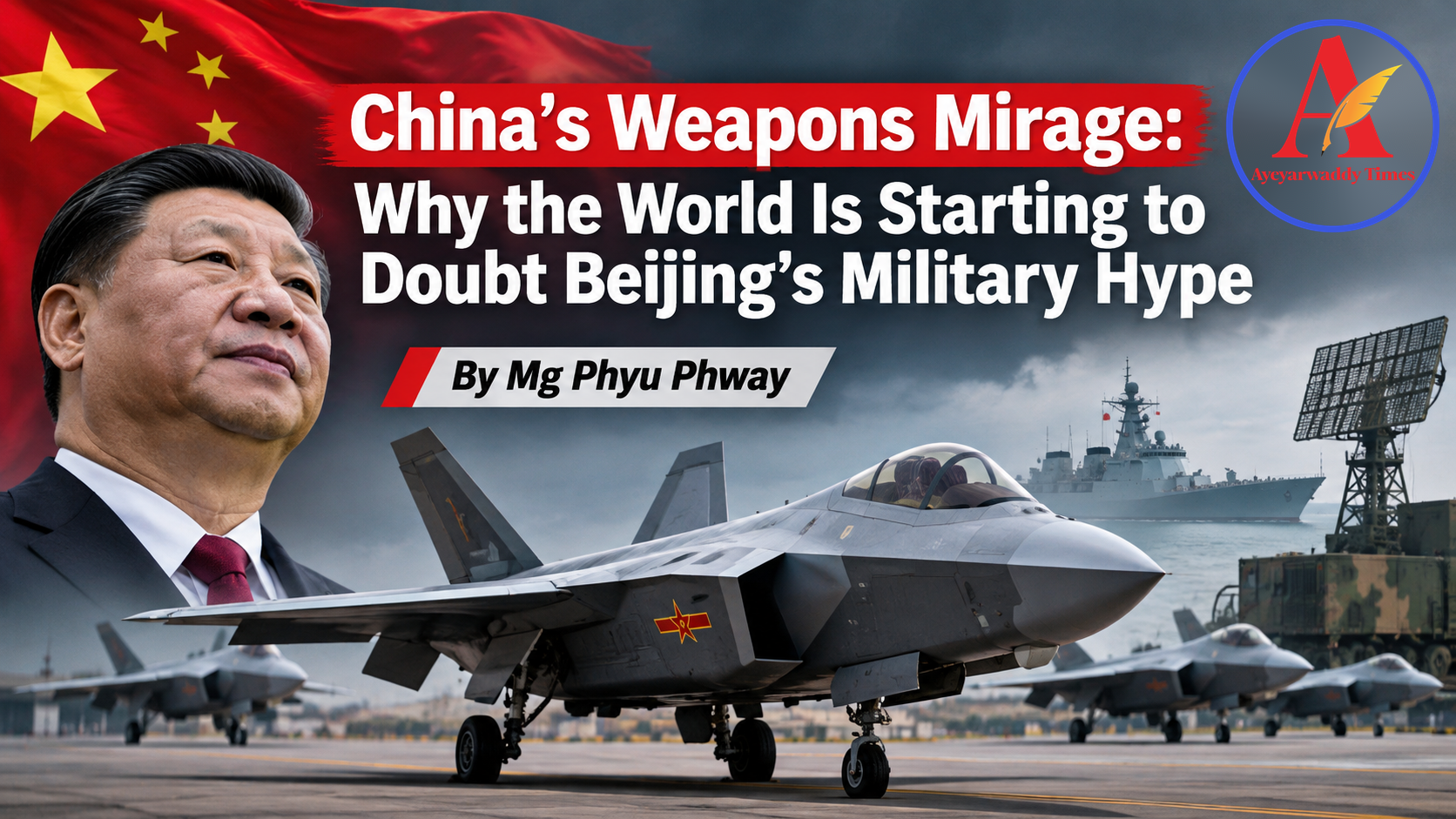
By Mg Phyu Phway
November 18, 2026
For years, China has projected an image of unstoppable military power. State media videos showcase stealth fighters roaring across the sky, hypersonic missiles streaking toward distant targets, and aircraft carriers symbolising Beijing’s rise as a global military force. To many observers, China appears to be rapidly closing the gap with the United States and its allies. Yet a growing body of evidence suggests that the gap between China’s military propaganda and battlefield reality may be far wider than Beijing would like the world to believe. The real test of military hardware is not a military parade, a glossy promotional video, or an air show demonstration. It is performance under the pressure of combat. Increasingly, questions are being raised about whether many of China’s exported weapon systems can withstand that test.
China remains among the world’s largest arms exporters, ranking among the top five global suppliers of major weapons systems according to SIPRI’s latest arms transfer data. However, unlike Western manufacturers whose products have decades of combat records behind them, many Chinese systems remained relatively unproven in high-intensity warfare. Recent assessments indicate that China’s arms exports remain heavily concentrated among a limited group of customers, with Pakistan accounting for a dominant share of Beijing’s weapons sales. More importantly, reports from several importing nations have fuelled concerns about reliability, maintenance challenges, spare-part shortages and overall quality control. Various defence analyses have documented recurring complaints involving China-made fighter aircraft, naval platforms, radar systems and air-defence equipment. Countries including Pakistan, Myanmar, Bangladesh and several African customers have at different times faced technical issues with Chinese-origin military hardware.
China has invested heavily in modern combat aircraft, including the J-10, J-20 and the newer J-35 stealth fighter. Yet engine technology has long been regarded as one of the most difficult obstacles facing China’s aerospace industry. For years, several Chinese combat aircraft relied on Russian-designed engines. The JF-17 fighter, exported to several countries, has traditionally depended on the Russian RD-93 engine, while early Chinese engine programmes were developed as replacements for Russian power plants. Even today, analysts continue debating the maturity and long-term reliability of some indigenous Chinese engine programmes. The fact that China spent decades trying to reduce dependence on Russian engine technology highlights a strategic vulnerability that Western aerospace powers largely solved many years ago. Military aviation experts often note that a fighter jet is only as good as its engine. Speed, endurance, payload, maintenance cycles and mission availability all depend on propulsion reliability. An advanced airframe means little if maintenance requirements are excessive or spare parts become difficult to obtain.
The export market has also delivered a reality check. While Chinese weapons are often marketed as affordable alternatives to Western systems, lower acquisition costs do not always translate into lower lifetime costs. Several buyers have been forced to address technical deficiencies, maintenance burdens or integration challenges after procurement. Reports have cited problems ranging from frigate systems to fighter aircraft and air-defence equipment, creating doubts among potential future customers.
This credibility issue may help explain why many nations continue to spend significantly more for American, European or Israeli weapon systems despite the higher price tags. When national security is at stake, reliability often outweighs affordability.
China’s defence industry has achieved remarkable manufacturing scale. It can build ships, aircraft, missiles and drones at impressive speed. However, industrial output alone does not automatically create combat effectiveness. Military power depends on training, logistics, maintenance networks, combat experience and technological reliability under extreme stress.
History shows that wars are rarely won simply by possessing impressive hardware. They are won by equipment that works consistently, by supply chains that remain resilient during conflict, and by personnel capable of adapting under pressure.
China’s armed forces have undergone extraordinary modernisation, and it would be a mistake to underestimate their capabilities. Beijing has invested hundreds of billions of dollars in its military transformation and continues to close technological gaps in multiple domains. But it would be equally mistaken to assume that every weapon featured in propaganda videos performs exactly as advertised.
The growing scrutiny of Chinese military exports demonstrates that many buyers are becoming more cautious. Military customers no longer evaluate weapons based merely on appearance or price. They examine operational records, reliability data, maintenance requirements and long-term support commitments.
The issue is not whether China can manufacture advanced-looking weapons. It clearly can. The issue is whether those weapons can consistently deliver when lives, missions and national security depend on them. As global competition intensifies, reputation matters as much as production capacity. A single battlefield failure can undo years of marketing. A malfunctioning missile, a grounded fighter aircraft, or an underperforming air-defence system can damage confidence far more than any propaganda campaign can repair.
In the end, military power is measured not by cinematic videos or nationalist slogans but by proven performance. And until more Chinese systems demonstrate sustained success under real-world operational conditions, doubts about the gap between Beijing’s propaganda and reality are likely to persist.
(The author, Mg Phyu Phway, is a researcher who studies and monitors Asia-Pacific affairs. This article represents the author’s personal views and opinions only and does not necessarily reflect the views or opinions of Ayeyarwaddy Times Media)
References:
- https://www.sipri.org/publications/2026/sipri-fact-sheets/trends-international-arms-transfers-2025
- https://idsa.in/publisher/issuebrief/jf-17-aircraft-exports-key-lessons
- https://defenceinnovationreview.com/2025/09/29/chinese-military-systems-face-reliability-crisis-amid-global-concerns/
- https://www1.ru/en/news/2026/06/03/rossiia-otkazalas-remontirovat-dvigateli-rd-93-kitaiskix-istrebitelei-jf-17-v-pakistane.html


