Mg Phyu Phway
November 12, 2026
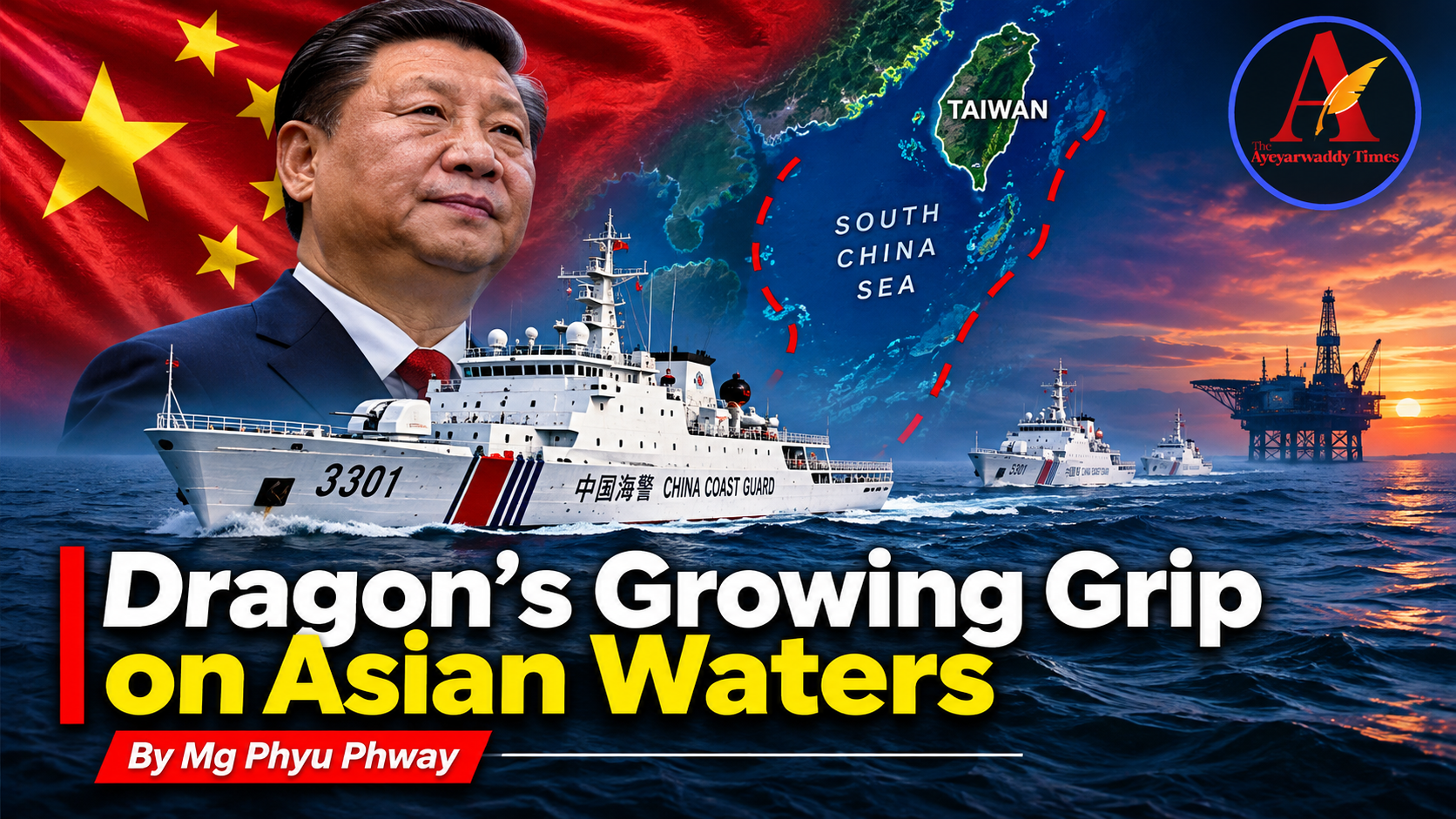
China’s latest coast guard patrols off Taiwan’s east coast are not merely routine maritime operations. They represent a steadily evolving strategy to normalise Chinese presence in waters that Taiwan regards as vital for its security and survival. According to Taiwan’s Coast Guard, Chinese vessels have intensified patrols east of the island since June 2026, while the latest operation involved radio communications that Taipei described as harassment of shipping and an attempt to impose a “fictional jurisdiction” over waters where China has no internationally recognised authority. Taiwanese officials believe these patrols are part of preparations for a potential maritime blockade, using a combination of military, coast guard, research, and civilian vessels to gradually alter realities at sea. Reports indicate that Taiwan has already expelled Chinese coast guard vessels from waters around the strategically important Pratas Islands 13 times this year alone.
The developments around Taiwan are only one element of a much broader pattern. In the South China Sea, China has spent years pressing its territorial claims against the Philippines, Vietnam, Malaysia, Brunei, and, at times, Indonesia. Filipino vessels operating near disputed reefs and shoals have repeatedly reported confrontations with Chinese coast guard and maritime militia ships. Vietnam continues to face pressure around contested waters in the Spratly and Paracel island chains. Malaysia has protested Chinese vessels operating near its offshore energy projects, while Indonesia has repeatedly rejected Chinese claims near the Natuna Islands. What emerges is an unmistakable strategy of incremental expansion, often called “grey-zone” activity, where coast guard ships, fishing fleets, and research vessels are deployed to pursue strategic objectives without crossing the threshold of open military conflict.
For the Philippines in particular, the challenge remains acute. The 2016 South China Sea Arbitration ruling concluded that China’s sweeping nine-dash-line claims had no legal basis under the United Nations Convention on the Law of the Sea (UNCLOS). Yet Beijing has continued to reject that ruling and maintain its expansive claims. The dispute is no longer just about reefs or rocks; it is increasingly about controlling access to fisheries, strategic shipping lanes, and offshore resources. The South China Sea carries a substantial share of global maritime trade and contains significant fishing grounds that support millions of livelihoods across Southeast Asia. Control over these waters translates into economic leverage, energy security, and geopolitical influence.
To understand the present situation, it is important to revisit the background. China’s maritime claims in the South China Sea stretch back decades, but they became significantly more assertive during the past fifteen years. Large-scale land reclamation projects transformed reefs into fortified outposts with airstrips, ports, radar installations, and military facilities. Simultaneously, Beijing expanded the role of its coast guard and maritime militia. The objective appeared to be creating facts on the ground, or rather facts at sea, that would gradually strengthen Chinese control without triggering a full-scale regional conflict. The same model is now becoming increasingly visible around Taiwan’s eastern waters, where coast guard patrols are being accompanied by research vessels, fisheries enforcement operations, and even militia-linked fishing boats. Analysts view these overlapping activities as part of a broader governance strategy that seeks to establish a continuous Chinese presence across contested maritime zones.
In the present context, China’s motivations extend beyond questions of sovereignty and national prestige. The waters surrounding Taiwan and across the South China Sea are believed to contain valuable fisheries, hydrocarbons, and undersea mineral resources. For a country of more than 1.4 billion people and the world’s largest manufacturing base, access to secure supplies of energy, seafood, and strategic minerals carries enormous economic significance. Fisheries support food security. Offshore oil and natural gas can reduce dependence on foreign energy imports. Critical minerals contained in seabed deposits may become increasingly important for advanced industries, batteries, renewable energy systems, electronics, and defence technologies. Control over maritime resources also strengthens export capacity and industrial competitiveness. While Beijing publicly frames its actions as defending sovereignty and maritime rights, critics argue that economic resource acquisition and long-term strategic dominance are equally important drivers.
The danger is that such maritime ambitions create growing instability across the Indo-Pacific. What begins as coast guard patrols can evolve into persistent pressure, restricted navigation, economic coercion, and eventually military confrontation. Taiwan’s eastern coast is especially sensitive because it serves as a potential supply corridor in any future crisis. If China succeeds in establishing a permanent operational presence there, regional security calculations could change dramatically. Likewise, continued pressure on the Philippines and other Southeast Asian nations risks undermining established international maritime norms. Smaller states may increasingly find themselves navigating between economic dependence on China and concerns over their own sovereignty.
Ultimately, the issue confronting Asia today is bigger than Taiwan, the Philippines, or even the South China Sea. It is a test of whether international law, freedom of navigation, and sovereign rights will remain the foundation of the maritime order. China’s growing maritime reach demonstrates that the contest for influence in the Indo-Pacific is increasingly being fought not only by naval fleets, but by coast guards, fishing vessels, research ships, and legal claims. The outcome of that contest will shape the balance of power across Asia for decades to come.
(The author, Mg Phyu Phway, is a researcher who studies and monitors Asia-Pacific affairs. This article represents the author’s personal views and opinions only and does not necessarily reflect the views or opinions of Ayeyarwaddy Times Media)
Hyperlinks:


