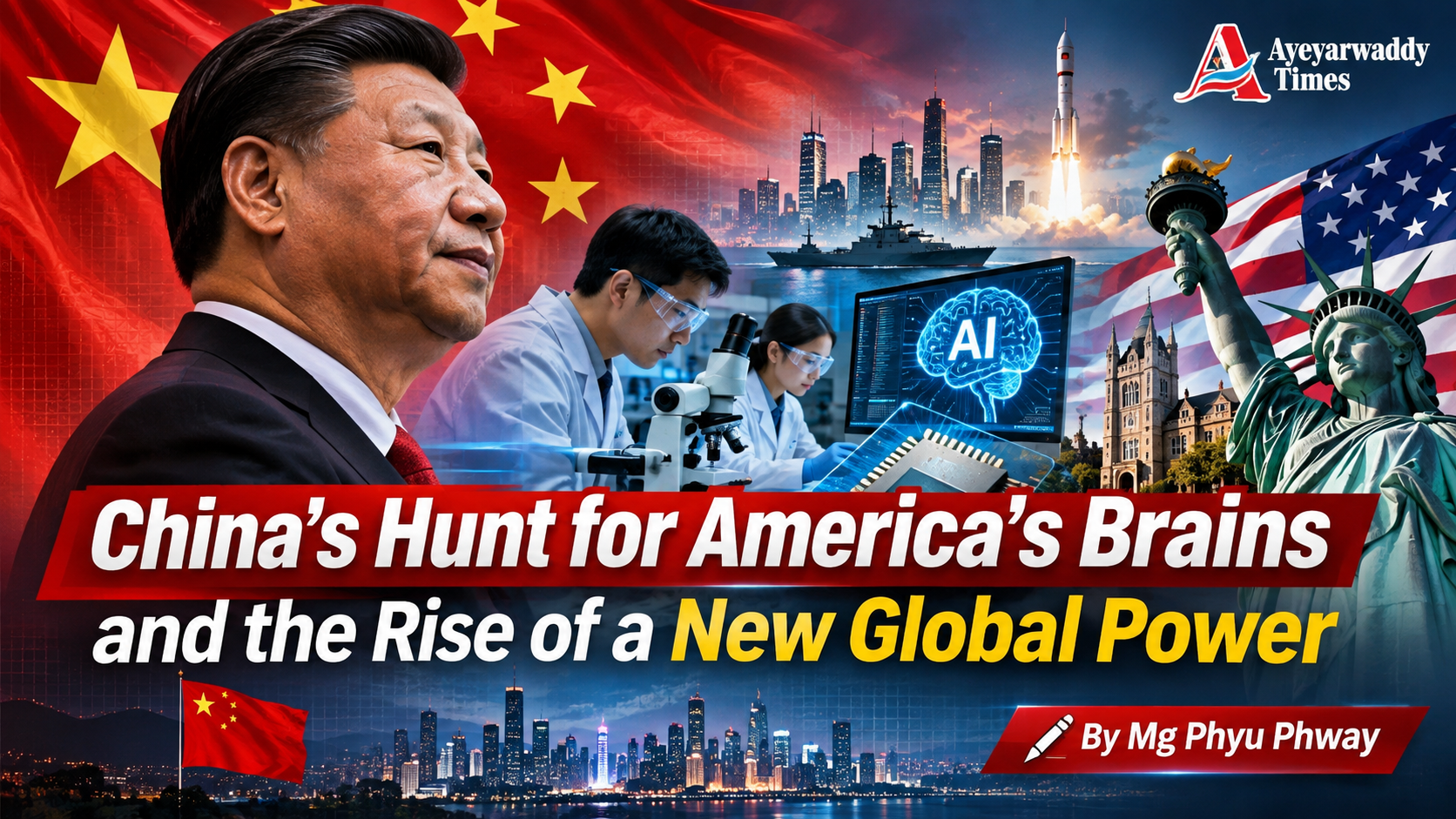
By Mg Phyu Phway
November 8, 2026
China wants to become the world’s foremost military and economic power. To achieve that ambition, Beijing understands that wealth, military strength, and geopolitical influence increasingly depend on one factor above all others: technological supremacy. The age when great powers competed primarily through industrial output or military manpower is fading. Today, the race is being fought in laboratories, research institutes, semiconductor facilities, artificial intelligence centres, and quantum computing hubs. Recognising this reality, China is aggressively positioning itself to attract top scientific talent from around the world, particularly from the United States, where many of the world’s leading researchers have long worked and innovated.
Recent reports of distinguished scientists leaving American universities for positions in China are not isolated incidents. They reflect a broader trend that Beijing has been carefully cultivating for years. China has expanded research funding, built world-class facilities, and offered lucrative salaries, housing benefits, start-up capital, and generous grants to attract researchers in strategic fields such as artificial intelligence, biotechnology, advanced materials, semiconductors, aerospace engineering, and quantum technologies.
According to official Chinese figures, the country’s research and development expenditure reached approximately 3.6 trillion yuan in 2024, making it one of the world’s largest investors in scientific research. China’s leadership openly views global talent as a strategic resource in its quest for technological self-reliance and global influence.
For Beijing, attracting foreign-trained scientists is not merely an academic exercise. It is a long-term strategic investment. Every researcher brought back from the West carries valuable expertise, professional networks, research techniques, and knowledge gained from some of the world’s most advanced institutions. In sectors that may define future military and economic competition, such intellectual capital can prove as valuable as natural resources or military assets.
The implications of this trend extend far beyond academia. Artificial intelligence, quantum computing, autonomous systems, space technology, and biotechnology will influence national security, economic competitiveness, intelligence gathering, and military power throughout the twenty-first century.
A China that succeeds in dominating these technologies would not simply become richer. It would acquire new tools to project influence, shape global standards, and potentially challenge the international balance of power established after the Second World War.
Those concerns are amplified by Beijing’s conduct in its own neighbourhood. Critics point to a pattern of behaviour that raises questions about how a technologically superior and economically dominant China might exercise power in the future. In the South China Sea, Beijing has expanded its military presence on artificial islands, deployed coast guard and maritime militia vessels, and asserted sweeping territorial claims that overlap with those of several neighbouring countries.
The 2016 Hague-based arbitration tribunal ruled overwhelmingly in favour of the Philippines and found no legal basis for China’s expansive “nine-dash line” claims under international law. Nevertheless, Beijing rejected the ruling and continues to uphold its claims while maintaining activities in disputed waters.
Taiwan remains another major flashpoint. Beijing continues to regard the self-governed island as part of its territory and has repeatedly increased military pressure through aircraft sorties, naval deployments, and military exercises around the island. Analysts increasingly view these activities as part of a broader effort to demonstrate military capability and shape political outcomes without direct conflict.
Beyond maritime disputes, China has frequently been accused of employing incremental territorial expansion strategies. Critics often describe these actions as attempts to alter facts on the ground while avoiding full-scale confrontation. Such concerns have contributed to growing scepticism among many governments regarding Beijing’s long-term strategic intentions.
Supporters of China argue that every major power seeks influence and security and that Beijing’s actions reflect its desire to safeguard national interests. However, many strategic observers view the current talent recruitment drive through a geopolitical lens. They see it as one component of a larger effort to reduce dependence on Western technology, overcome export controls, strengthen military-civil fusion programmes, and accelerate China’s rise as a comprehensive superpower.
If this strategy succeeds, the China of the 2040s and 2050s could look dramatically different from today’s China. It may possess world-leading capabilities in artificial intelligence, dominate large parts of the semiconductor supply chain, lead quantum communications, command advanced military systems, and exercise enormous influence over global digital infrastructure. Such a combination of technological, economic, and military strength would enhance Beijing’s ability to shape international institutions, establish technological standards, influence global markets, and exert pressure on smaller countries.
Whether that amounts to global hegemony remains uncertain. History shows that great powers require not only military and economic strength but also trusted alliances, political legitimacy, and attractive institutions. Yet there can be little doubt that China’s campaign to attract scientific talent represents far more than a human resources initiative. It is part of a long-term national project aimed at shifting the balance of global power.
The world’s democracies should not underestimate the significance of this transformation. The contest is no longer merely about who manufactures more goods or commands larger armies. It is about who develops the next generation of technologies that will define economic prosperity, military effectiveness, and political influence for decades to come. If China succeeds in concentrating technological, economic, and military power on an unprecedented scale, many countries will inevitably question what such a future would look like.
Beijing’s record in the South China Sea, its continued pressure on Taiwan, its rejection of the 2016 Hague arbitration ruling on the Philippines’ maritime claims, and its frequent territorial disputes with neighbours have fuelled concerns about how a far more powerful China might wield its influence. A technologically dominant and militarily superior China could become increasingly assertive toward perceived rivals and opponents, leaving smaller nations with fewer options to resist political, economic, or strategic pressure. In that competition, every scientist matters, every breakthrough counts, and every lost opportunity carries consequences that may shape the global balance of power for generations to come.
(The author, Mg Phyu Phway, is a researcher who studies and monitors Asia-Pacific affairs. This article represents the author’s personal views and opinions only and does not necessarily reflect the views or opinions of Ayeyarwaddy Times Media)
Hyperlinks
1:https://www.nature.com/articles/d41586-025-01750-4
2;
3: https://www.uscc.gov/research/south-china-sea-arbitration-ruling-what-happened-and-whats-next


