By Mg Phyu Phway
October 28, 2026
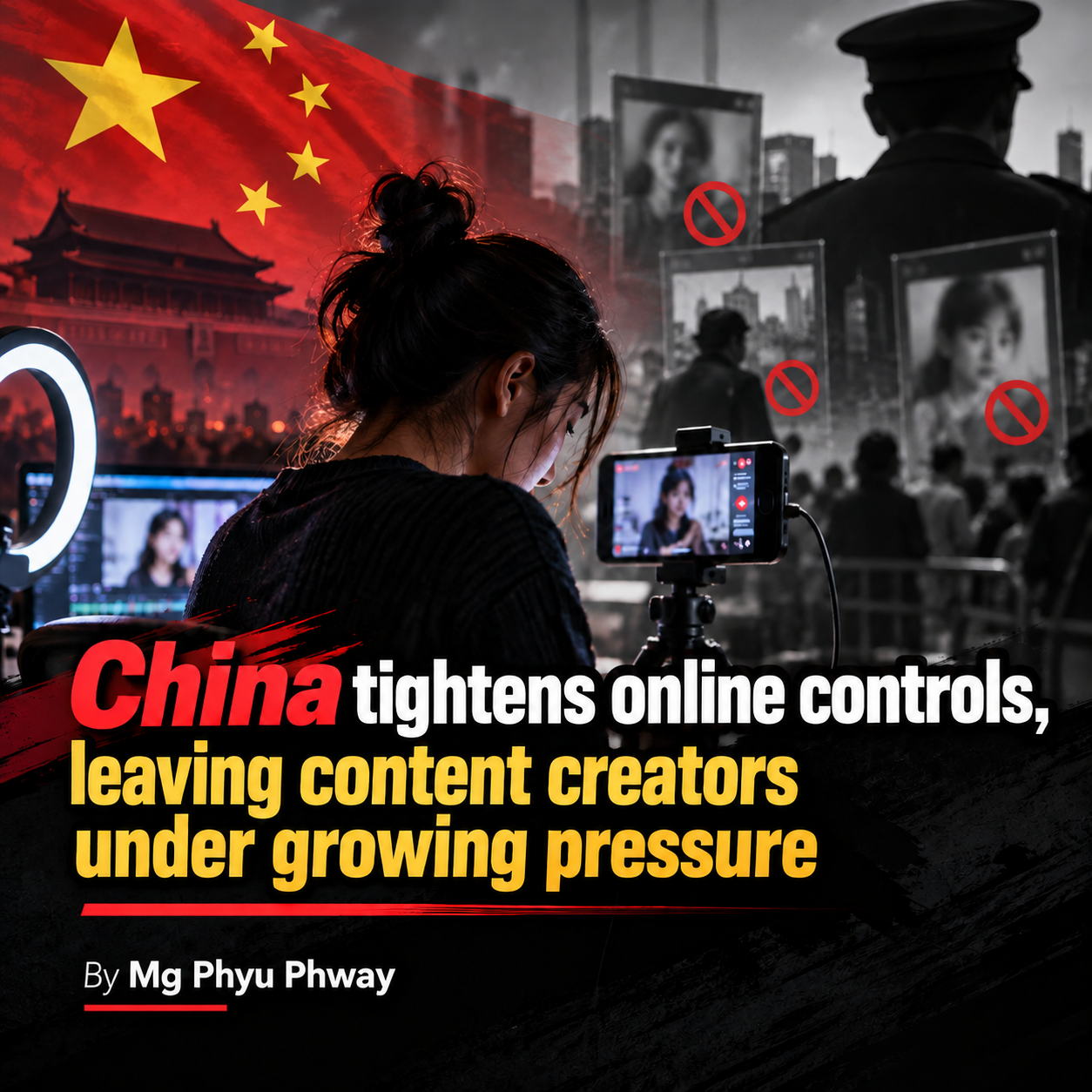
China’s digital creators are facing a new layer of regulatory scrutiny as Beijing extends its oversight beyond social media platforms to the companies, studios and account-management teams that help produce and distribute online content.
The latest rules, which came into force on September 1, have raised concerns about the risks facing people whose livelihoods depend on publishing material that attracts public attention.
For a country where short videos, livestreams and social media accounts have become important sources of information and income, the changes reach deep into the online content economy.
The regulations place formal responsibilities on content-distribution businesses and give platforms greater scope to restrict accounts, suspend monetisation or close channels over alleged violations.
Chinese authorities say the measures are intended to tackle misinformation, fabricated online identities and content that fuels social hostility.
Critics, however, fear that broad restrictions on what regulators describe as negative or misleading information could also discourage reporting on unemployment, unpaid wages, unfinished housing projects and public protests.
The central concern is not only what authorities may remove, but what creators might decide not to publish in the first place.
New rules widen regulatory reach
The Cyberspace Administration of China (CAC), together with four other government departments, announced the Regulations on the Management of Multi-channel Distribution Services of Internet Information Content on May 29.
The rules took effect on September 1, establishing a regulatory framework for businesses involved in planning, producing, distributing, marketing, promoting and managing online content.
The regulations require covered service providers to register and comply with relevant administrative requirements. Businesses already registered for these activities were given 30 days from the rules’ commencement to amend their registrations.
Companies engaged in online performances, publishing, audiovisual services or internet news must also hold the relevant licences.
Covered organisations must appoint people responsible for content management, establish management teams and introduce procedures for staff conduct and emergency responses. When contracting creators, they must verify their identities and define their management responsibilities.
The framework also extends potential consequences to creators associated with companies accused of breaching laws, regulations, platform rules or contractual obligations.
Depending on the circumstances, platforms may restrict account functions, suspend revenue-generating activities or shut down accounts.
The provisions prohibit a range of activities, including fabricating stories, manipulating information to mislead audiences, exploiting old news to generate misleading narratives and stirring up hostility between social groups or regions.
They also target fabricated online personas and artificial inflation of engagement figures.
These categories cover identifiable forms of online deception. Yet their application also places considerable importance on how regulators and platforms interpret the material being published.
Unclear boundaries fuel anxiety
In a report published in September, The Epoch Times quoted Chinese creators and commentators who expressed concern that the regulations could affect small studios and independent operators as well as established multi-channel networks.
A creator in Shenyang said people who rely on livestreaming income could face greater uncertainty as their audiences grow.
“Many people doing livestreams don’t know what they can say and what they can’t say. Once the traffic gets high, the risks come with it,” she told the newspaper.
She also questioned how authorities would determine whether a creator had incited public emotions or spread misleading information, arguing that the standards were not sufficiently clear.
Another commentator told The Epoch Times that small studios offering video editing, advertising and promotional services might not previously have considered themselves part of the regulated multi-channel network industry.
The new requirements, he said, could bring such operations within the compliance system.
The implications extend beyond registration paperwork. Smaller creators and studios may have fewer resources to manage legal obligations, documentation and content reviews.
Where businesses face potential penalties for material published by the accounts they manage, they have a direct incentive to scrutinise content before it reaches the public.
The result could be a system in which regulatory pressure travels through several layers: from authorities to platforms, from platforms to content-management companies, and from those companies to individual creators.
Social problems become a sensitive subject
The most contentious implications concern material about economic hardship and social grievances.
An independent creator in Harbin, identified by The Epoch Times only by his surname, Li, said he follows issues including gig employment, struggling businesses, unfinished housing projects and difficulties withdrawing money from banks.
Li expressed concern that sustained coverage of such subjects could be interpreted as an attempt to exploit negative incidents for online traffic, even when the information was accurate.
“Some content is not false; it’s just different from what the official releases say,” he told the newspaper.
His concern reflects a distinction that can become difficult to navigate in a tightly regulated information environment: the difference between fabricated claims and factual accounts that challenge an official version of events.
The regulations do not explicitly declare all critical reporting or discussion of social problems unlawful.
Their provisions focus on conduct such as misleading the public, fabricating information and inciting hostility. However, critics cited by The Epoch Times fear that the breadth of some categories could leave creators uncertain about where legitimate commentary ends and a punishable violation begins.
That uncertainty can influence editorial decisions before any regulator intervenes.
A creator who depends on advertising revenue, livestreaming payments or a large follower base has an immediate financial reason to avoid subjects that could trigger complaints or account restrictions.
Li described this potential effect as self-censorship. If creators conclude that publishing a contentious but accurate account could threaten their income, they may choose silence rather than risk losing their audience.
Enforcement campaigns intensify scrutiny
The new framework has arrived alongside a series of campaigns targeting online content that Chinese authorities consider misleading, harmful or commercially deceptive.
In May, the CAC announced a nationwide push to standardise labels on short videos. The regulator said that, since the beginning of 2026, platforms had removed more than 520,000 videos considered non-compliant and taken action against more than 68,000 accounts.
The labelling system requires creators to select a category before publishing. The six mandatory options cover fictionalised content, AI-generated material, marketing, reposted content, personal opinion and content that does not require a label.
Authorities said the measures were designed to make the origin and nature of online material clearer to audiences.
A separate enforcement drive targeting misuse of artificial intelligence produced further large-scale action.
According to figures released by the CAC and reported by state news agency Xinhua on September 3, authorities removed more than 5.61 million pieces of unlawful or rule-violating content and acted against over 49,000 accounts.
More than 2,400 websites and applications were also dealt with.
The campaign targeted AI-generated misinformation, violent or vulgar material, impersonation of real people and content that infringed on minors’ rights.
Major platforms, including Douyin, Kuaishou, Weibo and WeChat, were among the services operating under the intensified scrutiny.
On September 30, the CAC announced another two-month campaign focused on fabricated personas in short videos.
The targets included creators pretending to be vulnerable workers or impoverished rural residents to attract sympathy and sell products, people falsely claiming professional qualifications, and accounts publishing staged stories involving domestic violence, abandonment, missing persons or other conflicts.
The regulator said platforms should strengthen reviews, prevent offending videos from appearing in recommendation lists and ban accounts in serious cases.
These examples demonstrate how enforcement now reaches not only the publication of individual posts but also the commercial arrangements, distribution networks and recommendation systems that can amplify them.
Financial penalties add to the pressure
The new regulations operate alongside existing laws and administrative rules. Where a specific penalty is not prescribed elsewhere, the provisions allow authorities to issue warnings and impose fines ranging from 10,000 yuan to 200,000 yuan, according to the account published by The Epoch Times.
For creators, however, formal fines are only one potential cost. Losing access to an established account can mean losing followers, advertising contracts and a regular source of income.
A suspension of monetisation can have an immediate effect even if a creator is not permanently banned.
The rules also create a strong incentive for intermediaries to limit their own exposure. A platform or management company that fears regulatory action may remove questionable material before an official order arrives.
Creators working under contracts may then face restrictions imposed by companies seeking to protect their licences and business operations.
This arrangement makes enforcement less dependent on direct intervention in every post.
Responsibility is distributed across the commercial system that produces and circulates online content, while individual creators carry the consequences of decisions made by regulators and platforms.
A narrower space for independent voices?
China’s latest measures form part of a wider regulatory approach in which online content is subject to requirements covering registration, identity verification, labelling, distribution and platform accountability.
The September campaigns against AI misuse and fabricated online personas show that scrutiny continues beyond the introduction of the new rules.
The authorities have identified specific concerns, including fabricated information, deceptive marketing and the misuse of artificial intelligence. But the questions raised by independent creators centre on how consistently the rules will be applied when content concerns sensitive economic or social issues.
For people reporting on unfinished homes, unpaid wages, business failures or public grievances, the practical calculation may increasingly involve more than whether a claim can be substantiated.
They must also consider whether a platform will regard the material as harmful, whether a management company will accept the risk and whether publication could jeopardise their income.
The regulations do not establish that every account discussing an uncomfortable issue will face punishment.
Yet the combination of broad content restrictions, extensive platform responsibilities and the possibility of losing access to an audience creates a climate in which creators may hesitate before publishing.
In such an environment, the boundaries of permissible online discussion are shaped not only by content that authorities formally remove, but also by material that creators decide is too risky to share.
(The author, Mg Phyu Phway, is a researcher who studies and monitors Asia-Pacific affairs.)