By Mg Phyu Phway
October 11, 2026
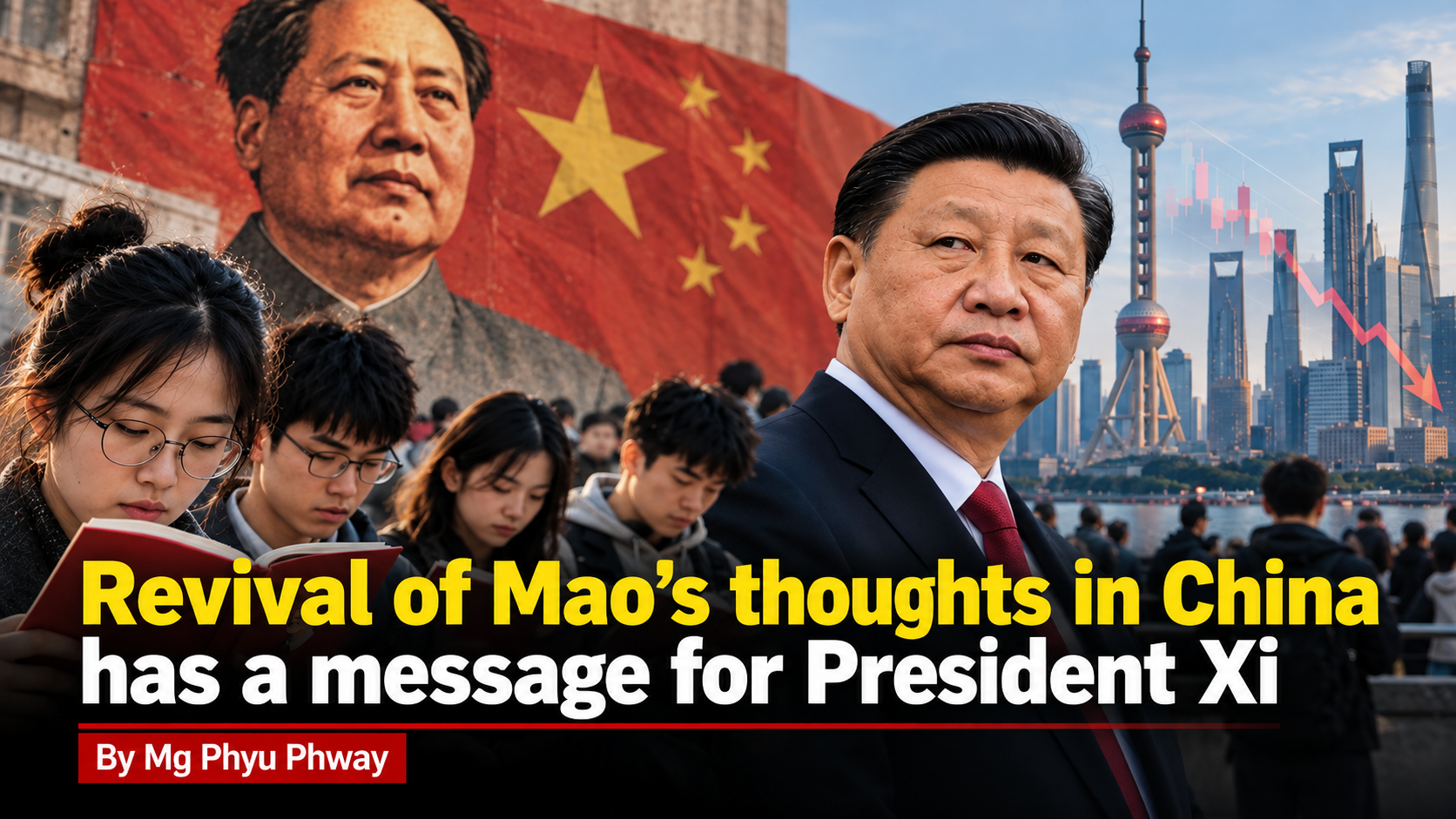
According to reports from Beijing, the Gen Z of China is falling back on Mao Zedong’s thoughts to find a cure for the problems they are facing: slowing down of the economy, increasing unemployment, rising social inequality. This carries a sobering message for President Xi Jinping’s regime too.
After Mao’s death, the ‘great helmsman’ had been roundly criticized for some of his political and economic campaigns; especially the Cultural Revolution in the course of which thousands had been killed in the name of purging ‘capitalist roaders.’ The Chinese economy had descended into chaos. Mao had later been assessed as ‘70 percent correct and 30 percent wrong.’
But the trend is changing, especially among the youth and students. His words and writings are finding renewed traction among the Chinese youth. As people face the significant slowing down of the Chinese economy from the days of double-digit growth. 62 percent of the Chinese Gen Z youths worry about job security, Mao’s thoughts are finding a new audience among China’s Gen Z. At the Tsinghua University in Beijing, the Selected Works of Mao Zedong topped the list of library loans last year. On the online shopping platform Taobao, a shop sold more than 20,000 units of an enamel mug with Mao’s portrait over the past year.
Youths have formed online reading groups around his work, while videos prepared with Artificial Intelligence and social media posts have introduced Mao’s speeches and writings to a generation with no direct experience of the Mao era. Online influencers have built large followings by presenting Mao’s writings as practical guides for dealing with setbacks in work and everyday life.
Along with economic slowdown, the inequality levels are rising in China; with the bottom 50 percent of the people earning about 15 percent of the total income and the top 10 percent enjoying 67 percent of the total wealth of the country. This inequality level is only marginally lower than that in the US where the comparable figures are 12 percent and 72 percent but higher than in France where the comparable figures are 22 percent and 50 percent, according to a Stanford University study.
In terms of Gini coefficient (where the perfectly equal society has a score of 0 and a perfectly unequal society a score of 1, China’s score of 0.4 represents a highly unequal society. By comparison, Germany, Canada and Japan have coefficients around 0.3; and the US too has a score below China’s.
With the official urban unemployment rate for people in the age group 16 to 24 years hitting a record high of 21.3 percent in China and the sustained downturn in the prices of real estates, an asset in which the middle-class Chinese people have invested heavily, the Chinese youths are apprehensive about their future. They feel Mao’s theory of class struggle can close the widening wealth gap.
This has opened up the possibility of Xi’s top-down model of governance with power concentrated around himself coming under the scrutiny of Mao’s idea of continuing revolution to cleanse the upper echelons of the party and the government through mass mobilization, an idea that the founder of communist China had championed during the Cultural Revolution.
In the past 50 years since Mao’s death in 1976, things have changed much in China. Under the market reforms introduced by Mao’s successor Deng Xiaoping, China had moved away from the initial days of hardcore communism. Private property, shunned by Mao, had been reintroduced and foreign investments had been welcomed. By limiting the tenure of the President of China to a two-year term, Deng had introduced democratic reforms in the communist system of governance too.
To an extent, Xi Jinping has taken China back to the days of Mao. State-controls are on the rise, foreign investors are finding it increasingly difficult in China, the two-term tenure of the President has been abolished and President Xi himself is now at the end of his third term; aiming for the fourth.
It will be wrong, however, to equate Xi’s rule with the Mao era. China has not returned to the Mao-era model of a communist welfare state. In today’s China a strong private sector co-exists with state capitalism with a mix of ownership forms. Mao’s idea of a self-reliant economy is no longer practicable. Today China cannot withdraw from the global economy and the international supply chains.
The top-down model of governance which President Xi has introduced, usurping for himself the three most powerful positions in the hierarchy in China — the President, the General Secretary of the Chinese Communist Party and the Chairman of the Central Military Commission — runs counter to Mao’s idea of Cultural Revolution: delegating the supreme power to the masses.
Mao, of course, could afford to delegate power to the masses because of his unique position as the leader of the communist revolution in China. With his personal charisma he could bypass the party institutions and mobilize the masses against the party and the state apparatus to suit his political ends. In 1966-67, described as the most radical period of the Cultural Revolution, Mao had encouraged the collapse of the party-state system at the grassroots level.
Xi does not enjoy the same commanding influence. Observers have pointed out that the way Xi exercises power is different from the way Mao had. Xi will never allow the collapse of the party-state system and is consolidating power by strengthening institutions and the party apparatus.
His emphasis is on control and top-down governance. Xi’s style of governance, centralization of power and internal party purges, removing numerous officials and military officers, has been compared with the Stalinist era of absolute control in the former Soviet Russia. Xi has dismantled Deng Xiaoping’s model of collective leadership in the Chinese Communist Party.
Analysts have said that Mao’s China in many respects was more unequal than it is today, but the Gen Z of China, which has no direct experience of the Mao era, is falling back on an imagined vision of a more equal China in the era of Mao Zedong. Some of them are invoking Mao’s language of anti-bureaucratic struggle, resistance against oppression and are criticizing what they see as corruption, inequality and abuse of power in Xi’s China.
The surge in nostalgia for Mao Zedong’s classical teachings among the Gen Z of China raises for President Xi’s administration the spectre of the revival of the ideal of the Cultural Revolution and a renewed focus on radical class struggle to legitimize protests against state policies, government officials and exploitation of labour.
Understandably, when online discussions on Maoism border on calling for active resistance against accumulation of wealth, the posts by radical student groups are swiftly blocked. It may not be just a coincidence that the formal observance of Mao’s 50th death anniversary in China was a subdued one, with no major coverage in the official media and no report of ceremonies; while 60,000 common Chinese people made appointments to visit the Chairman Mao Memorial Hall in Beijing and pay their respects.
(The author, Mg Phyu Phway, is a researcher who studies and monitors Asia-Pacific affairs.)