By Mg Phyu Phway
November 24, 2026
India’s presence at the ASEAN summit in Manila on 16-17th November stood out as remarkable and vibrant. The vibrancy is not only embodied in PM Modi’s gifts embodying India’s rich cultural heritage (ranging from Kashmiri silk carpets, Chola bronze sculpture, silver, Bidri, Dokra, quartz, to rogan work) presented to ASEAN leaders[1], but also in high-level dialogues and diplomacy, from ASEAN centrality and cooperation to disaster management, youth and education, and citizen mobility.
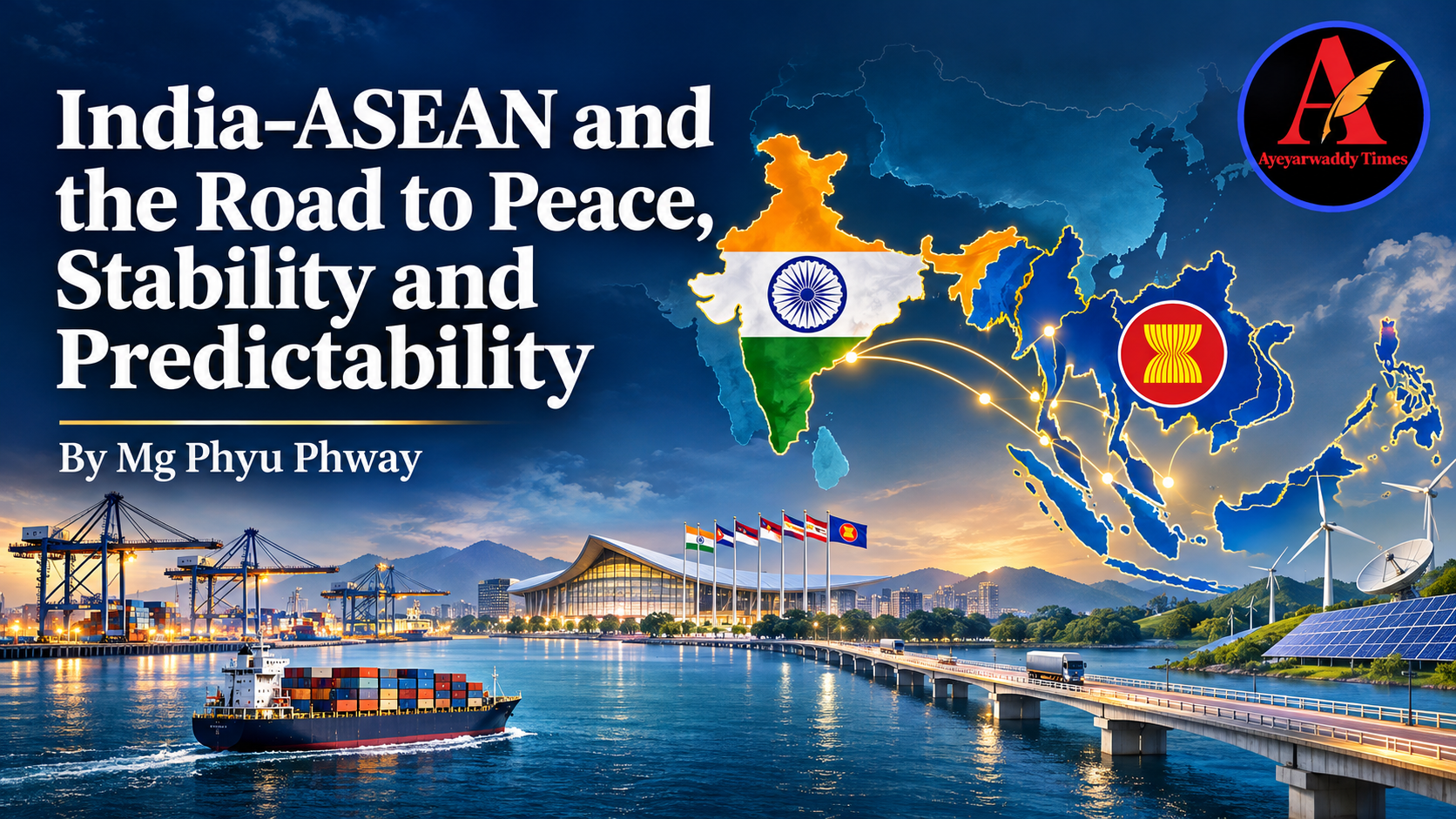
India’s commitment to Act East Policy has broadened ties beyond shared culture and heritage into digital technology, defence, space and denser people-to-people connect. The development of the region has always been intertwined with the shared focus on Indo-Pacific stability through maritime cooperation, trade and clean energy exchange between India and ASEAN nations. India’s Act East policy has given new momentum to the bilateral ties[2] over the last few years with the development of regional links such as the India–Myanmar–Thailand Trilateral Highway, the Kaladan Multi-Modal Transit Transport Project, and cross-border rail/road and border trade links. The Summit’s highlight, the “cooperation over competition” commitment becomes rather more crucial in the global order struck by a flurry of crises, supply chain shocks and dilapidating peace and stability. Amidst growing precarity, the initiatives announced in the Summit sit right at the core of the theme of “Navigating Our Future, Together”.
What stood out in the 23rd ASEAN-India Summit in Manila with the earlier dialogues is the paradigmatic shift in the partnership approach. Moving beyond traditional trade and cultural exchanges, the leadership steered toward frontier technology co-creation and long-term strategic vision alignment. This marks a shift in focus from standard trade facilitation to what PM Modi emphasized as an India-ASEAN partnership to co-create emerging technologies and jointly skill their populations, backed by robust technical proposals. The proposal included cooperation in space and nuclear ecosystem by launching an ASEAN-India Space Hackathon for young innovators and initiating ASEAN-India Nuclear Energy Technical Exchanges.
Besides, the meeting pivoted on synchronization of long-term strategic vision alignment via Multi-Decade Development Visions. Recognising India’s development and ASEAN’s prosperity as “deeply interconnected”, both sides explicitly anchored their diplomatic roadmap around aligning two long-term national and regional blueprints: ASEAN Community Vision 2045 and India’s Viksit Bharat 2047. This aims at conceptualising India’s economic rise and ASEAN’s integration as mutually reinforcing based on the principle of cooperation and not competition.
Experts opine that the summit highlighted the importance of people-to-people connect in South-South cooperation. This is evident in the announcement of free e-Visas for tourists across all ASEAN member states. The ASEAN-India Youth Connect, Youth Summit, Young Parliamentarian Exchanges, and start-up hackathons, alongside expanded India’s Nalanda University scholarships[3] also stood as crucial steps towards greater regional integration for the younger generation. Focusing on youth skill-building and technical training, a Joint Cyber Forensics Training Programme has been initiated to build digital investigation skills, building on India’s ongoing commitment of over 10,000 skill-building scholarships for the region[4].
The adoption of a joint statement on disaster management cooperation covering early warning systems, satellite data sharing, joint simulations, and AI in disaster response marks a commitment towards a disaster-resilient region, intending to deepen regional cooperation across prevention, preparedness, response, and recovery[5].
While on the Maritime and Security front, a long-term ASEAN-India Maritime Cooperation Plan (covering connectivity, scientific research, disaster management, Coast Guard cooperation, maritime domain awareness, and seafarers’ security) was announced, while on the Clean Energy front, India pushed for building institutional and technical capacity across Southeast Asia for the safe, peaceful use of civil nuclear energy. This is especially important and timely given several ASEAN nations explore nuclear power to meet rising electricity demand and net-zero climate targets. In this context, regulatory and operational expertise in nuclear safety, radiation protection, small modular reactors (SMRs), nuclear fuel cycle management, and non-power applications (such as nuclear medicine, agriculture, and water resource management) are key skills India has to offer. This initiative also complements the supply-chain initiatives launched at the summit, involving cooperation on critical minerals while reinforcing peaceful nuclear governance in the Indo-Pacific.
The two players will be commemorating the 35th year of their Dialogue Relations and five years of their Comprehensive Strategic Partnership in 2027. The diversification of issues for cooperation and consensus-building between India and ASEAN also speaks volumes about the growing strength of multilateralism, where the economies are unpacking the economic potential inherent in their formal and informal interactions, thereby laying the rules for regional order. As peace, stability, and predictability become rarer with growing global uncertainties, diplomatic ties ensuring this stability become frontrunners of regional prosperity and economic development. In this context, India and ASEAN’s commitment to navigate a future together reflects a spirit of reciprocity and win-win cooperation, while also becoming a manifestation of collective resilience against global upheavals.
(The author, Mg Phyu Phway, is a researcher who studies and monitors Asia-Pacific affairs. This article represents the author’s personal views and opinions only and does not necessarily reflect the views or opinions of Ayeyarwaddy Times Media)
[1] https://timesofindia.indiatimes.com/india/from-rajasthan-painting-to-kashmiri-carpet-what-pm-modi-gifted-to-asean-quad-leaders-during-manila-visit/articleshow/135948013.cms
[2] https://www.aninews.in/news/world/asia/act-east-policy-has-given-new-momentum-to-india-asean-relations-pm-modi-in-manila20261117140942/
[3] https://www.businessworld.in/article/india-proposes-maritime-cooperation-plan-cyber-training-programme-at-asean-summit-633992
[4] https://www.pmindia.gov.in/en/news_updates/pms-opening-remarks-at-the-23rd-asean-india-summit/
[5] https://www.mea.gov.in/bilateral-documents?dtl/41953